


Exception-based workflows




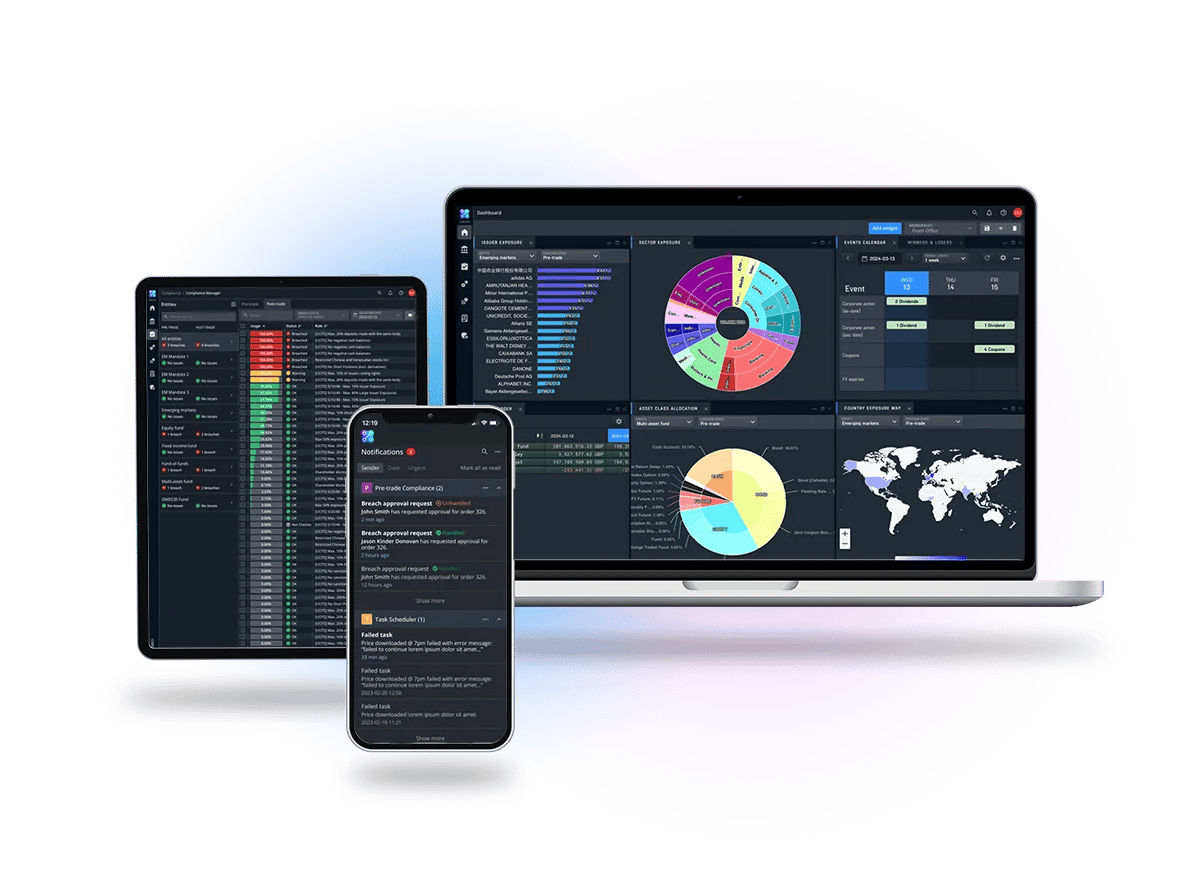






Asset Management Software: 6 Solutions Transforming Investment Operations in 2025
Institutional investors spend 1.3-2.7 basis points on technology while 60-80% of those budgets maintain legacy systems. That leaves precious little for actual innovation. Meanwhile, 90% of asset managers now use some form of AI, yet only 8% have completed cloud migration. The disconnect is costing firms real money—pre-tax operating margins declined 3-5 percentage points between 2019 and 2023.
This guide examines six leading asset management software platforms designed for institutional use, from nimble cloud-native solutions to established enterprise giants. Whether you're managing $100 million or $100 billion, understanding how these platforms differ on implementation speed, total cost, and technological architecture will determine whether your firm spends the next decade maintaining yesterday's technology or on building competitive advantage here and now.
Note: This analysis consolidates publicly available information as of November 2025, including vendor specifications, user reviews from G2 and Capterra, and industry analyst reports.
Quick Comparison: Leading Asset Management Software Platforms
| Platform | Reported AUM examples | Implementation style | Pricing Transparency | Cited Strength |
| Limina IMS | $0.1B-$30B | Quick to set up. Integration flexibility high. | Public ($70K-$400K+/yr) | Modern efficiency for small to mid-market |
| BlackRock Aladdin | $50B+ | Customised process. | Enterprise custom |
Industry-leading risk analytics |
| SimCorp Dimension | $20B+ | Customised process. | Enterprise custom | Comprehensive front-to-back integration |
| Charles River IMS | $5B+ | Customised process. | Enterprise custom | Best-in-class OEMS |
| SS&C Eze | Up to $0.5B with some larger outliers | Quick to set up. Boxed to what exists. | Enterprise custom | Modular execution platform |
| Clearwater Analytics |
$1B+ | Not well reported. | Enterprise custom | Investment accounting |
1. Limina IMS: Enterprise Capabilities Without Enterprise Complexity
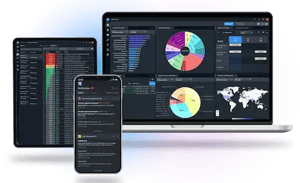
What it is: A cloud-native investment management platform purpose-built for growing asset managers who need institutional-grade capabilities without the bloat of legacy enterprise systems.
Who it's for: Asset owners, hedge funds and managers of mutual funds, mandates, ETFs managing $100 million to $30 billion in AUM.
Core capabilities:
- Real-time portfolio management with a powerful rebalancer and 300+ measures and analytics
- Integrated order management with connectivity to 300+ brokers
- No-code compliance rule builder for pre-trade and post-trade checks
- Exception-based workflows that automate routine tasks for both Operations and Front Office
- Generation 3 "Live-Extract" IBOR providing any portfolio view at any time without batch processing
- Self-service ETL tool for building any integration in minutes
- Multi-asset class support (equities, fixed income, derivatives, alternatives)
What makes it different: Transparent pricing: Limina is the only provider to publicly list pricing, starting at $70,000 annually for basic configurations and scaling to $400,000+ for high-volume firms. No AUM-based pricing means your software costs don't increase just because you grow.
Exceptional speed: Implementation typically ranges from weeks for new managers to 3-12 months for complex established firms, at what Limina claims is one-fifth the cost of competitive solutions. Compare this to the 12-24 month implementations typical of enterprise platforms.
Modern user experience: Portfolio managers using Limina spend an average of 14-15 minutes daily in the system versus over an hour in traditional platforms. Operations teams report 50% reduction in time spent on routine workflows.
True cloud-native architecture: Built from scratch from 2014 as cloud-native (not legacy systems retrofitted for the cloud), Limina updates automatically every few weeks with no downtime or manual upgrades required.
Best suited for: Growing asset managers seeking institutional capabilities without enterprise complexity, firms tired of opaque vendor pricing, teams wanting modern workflows that save hours daily.
Learn more:
2. BlackRock Aladdin: The Enterprise Standard for Risk
What it is: The industry's most comprehensive investment platform for institutional managers.
Who it's for: Very large institutions with $50B+ AUM—pension funds, insurance companies, sovereign wealth funds, etc.
Core Capabilities:
- Industry-leading risk analytics monitoring 2,000+ risk factors daily
Sophisticated Monte Carlo simulation and stress testing - Full portfolio lifecycle management from ideation to operations
Integration with BlackRock's research ecosystem - Private markets capabilities through eFront acquisition
What makes it different:
Aladdin represents the gold standard for institutional risk management. Its analytics engine processes massive datasets to provide unparalleled insights into portfolio risks across public and private assets. Recent cloud migration to Microsoft Azure has improved performance while maintaining enterprise-grade security.
Considerations:
- Cost and complexity: Implementations typically require quarters/years and enterprise-level budgets. Annual costs can reportedly reach millions, making it economically viable only for the largest institutions.
- Conflict of interest: BlackRock is both vendor and competitor, a potential concern for asset managers competing against BlackRock's investment management business.
- Overkill for mid-market: Firms managing under $50 billion often find Aladdin's capabilities exceed their needs while implementation complexity strains resources.
Well suited for example to: Global asset managers, pension funds, and insurance companies requiring the deepest available risk analytics and willing to invest in multi-year implementations.
3. SimCorp Dimension: Comprehensive Front-to-Back Integration
What it is: A Copenhagen based buy-side platform acquired by Deutsche Börse for €3.9 billion in 2023.
Who it's for: Large asset managers and asset owners with $10B+ AUM, particularly strong in European pension fund and sovereign wealth fund markets.
Core Capabilities:
- Industry-leading Investment Book of Record (IBOR)
- True front-to-back integration on a single platform
- Deep fund accounting and back-office automation
- Integration with Axioma for factor-based risk analytics
- Comprehensive regulatory reporting across jurisdictions
What makes it different:
SimCorp built its reputation on accounting excellence and IBOR capabilities (like Limina). The platform handles complex multi-asset, multi-currency portfolios with precision that satisfies the most demanding institutional requirements.
Considerations:
- Implementation timelines: Deployments typically require years, with extensive configuration and customization needs.
- Legacy architecture: While transitioning to cloud, SimCorp's hybrid architecture means some components still reflect its on-premise heritage, affecting upgrade flexibility.
Well suited for example to: Large European pension funds, insurance companies, and asset owners with complex requirements and resources for extensive customization.
4. Charles River IMS: State Street's Order Management Powerhouse
What it is: Acquired by State Street for $2.6 billion in 2018, supporting $59 trillion in assets across 280+ clients globally.
Who it's for: Large to mid-sized institutional asset managers, particularly those with existing State Street relationships.
Core Capabilities:
- Industry leading Order and Execution Management System (OEMS)
- Real-time positions and multi-asset class support
- Robust pre- and post-trade compliance
- Purpose built IBOR for front office
- Cloud-native deployment on Microsoft Azure
What makes it different:
Charles River's OEMS represents the industry standard for sophisticated order routing and execution management. The platform's compliance engine provides institutional grade controls with extensive pre-configured rule templates.
Considerations:
- State Street ecosystem dependency: Maximum value requires integration with State Street's broader services. Firms outside this ecosystem may face longer, more complex implementations.
- Risk analytics depth: While solid, Charles River's risk capabilities don't match Aladdin's sophistication, the platform prioritizes execution excellence over risk modeling.
- Integration complexity: Connecting to non-State Street custody and fund administration systems reportedly requires substantial technical coordination.
Well suited for example to: Institutional managers with complex compliance requirements or existing State Street custody relationships prioritizing execution quality.
5. SS&C Eze: Modular Trading for Hedge Funds
What it is: Part of SS&C Technologies' comprehensive portfolio, acquired for $1.45 billion in 2018, serving 1,900+ global asset managers.
Who it's for: Hedge funds, active managers, and multi-strategy funds prioritizing execution capabilities.
Core Capabilities of Eze Investment Suite:
- Modular platform offering separate OMS, EMS, and OEMS solutions
- Advanced order routing to 300+ liquidity sources
- Real-time positions and P&L
- FIX connectivity and broker integration
Eze Investment Suite is a collection of three systems: RealTick (Eze’s EMS), Eze OMS, and Eze PMA (formerly Tradar PMS, a portfolio accounting solution). Eze Eclipse is an alternative product from Eze (separate from Eze Investment Suite).
Eclipse is a cloud-native solution for faster deployment where needs are light.
What makes it different:
SS&C Eze's modular approach allows firms to implement components individually, ideal for organizations with existing systems wanting to upgrade specific functionality rather than replacing everything.
Considerations:
- Product fragmentation: As part of SS&C's acquisition strategy, Eze products sometimes overlap with other SS&C offerings (Geneva, APX, Genesis, Aloha), creating confusion about which solution fits specific needs.
- Module coordination: Managing data consistency between separate OMS, EMS, and portfolio accounting modules requires careful data architecture.
- Legacy technology: While Eze Eclipse is cloud-native, older products reflect their desktop heritage with interfaces that feel dated compared to modern alternatives.
Well suited for example to: Hedge funds and active managers where execution quality is paramount and modular flexibility outweighs single platform simplicity.
6. CWAN (formerly Clearwater Analytics): Investment Accounting Excellence
What it is: A SaaS financial platform that recently expanded through acquisition of Enfusion for $1.5 billion.
Who it's for: Insurance companies, asset managers, and institutional investors requiring sophisticated investment accounting and reconciliation.
Core capabilities:
- Industry-leading investment accounting and reconciliation
- Multi-asset class support with particular strength in fixed income and insurance portfolios
- Automated data aggregation from 1,000+ sources
- Regulatory reporting (NAIC, Solvency II, IFRS)
- Front-to-back expansion through Enfusion acquisition
What makes it different:
Clearwater built its reputation solving investment accounting complexity for insurance companies, handling intricate regulatory requirements, complex securities, and reconciliation at scale.
Considerations:
- Accounting-first platform: Historically focused on middle and back office; front-office portfolio management capabilities are newer (bolstered by Enfusion acquisition).
- Implementation scope: While faster than legacy systems, comprehensive deployments can still require quarters depending on organizational complexity.
- Evolving front-office: The Enfusion acquisition (closed in 2025) positions Clearwater as front-to-back, but integration is still in progress.
Well suited for example to: Insurance companies and institutional investors prioritizing accounting precision and regulatory reporting over front-office sophistication.
Decision Framework: Matching Platform to Firm
| If you are a... |
Consider... | Because… |
| Any type of investment manager seeking institutional capabilities without complexity | Limina IMS | Modern efficiency, transparent pricing, fastest implementation, 50% time savings |
| Global institution requiring deepest risk analytics | BlackRock Aladdin | Industry-leading risk modeling, proven at massive scale |
| European asset owner with complex requirements | SimCorp Dimension | Comprehensive front-to-back, strong regulatory reporting |
| Existing State Street client prioritizing execution | Charles River IMS | Seamless ecosystem integration, best-in-class OEMS |
| Hedge fund needing execution excellence | SS&C Eze | Modular trading platform, 300+ liquidity sources |
|
Insurance company prioritizing accounting |
Clearwater Analytics | Investment accounting excellence, regulatory compliance |
What to Ask Vendors (Beyond the Demo)
On implementation:
- "What's your median time to first production portfolio, not your fastest case study?"
- "What percentage of implementations finish on original timeline and budget?"
- "How many integrations are included vs. custom projects?"
On total cost:
- "What's included in the base price vs. additional fees?"
- "What do your top 10 clients actually spend annually, including all services?"
- "What happens to pricing as we grow AUM?"
On ongoing partnership:
- "How often do you update the platform? Is downtime required?"
- "Can we build our own integrations or must we wait for vendor projects?"
- "What's your median customer support response time for urgent issues?"
On technology:
- "Is this cloud-native or legacy architecture moved to cloud?"
- "Can portfolio managers access real-time data or is processing batch-dependent?"
- "What's your technology roadmap for AI integration?"
The Bottom Line
Asset management software selection determines whether your firm spends the next decade maintaining yesterday's technology or building tomorrow's competitive advantage.
For growing firms seeking institutional capabilities without enterprise complexity, Limina IMS delivers the rare combination of modern architecture, transparent pricing, and exceptional speed.
For the largest institutions requiring the deepest risk analytics or the most comprehensive customization, enterprise platforms remain relevant despite their complexity and cost. But recognize the tradeoff: multi-year implementations, opaque pricing, and ongoing vendor dependency in exchange for proven scale.
The firms that thrive through the next decade won't be those with the biggest technology budgets. They'll be those with the most agile infrastructure—platforms that update automatically, integrate effortlessly, and free teams to focus on investment decisions rather than system administration.
Ready to evaluate your options?
Analysis based on publicly available information as of November 2025, including vendor specifications, user reviews from G2 and Capterra, industry analyst reports from Accenture, McKinsey, and Oliver Wyman, and market research from Mordor Intelligence and others.
Ready to evaluate equity portfolio management platforms?
Test with your portfolios. Verify capabilities. Calculate ROI.
Analysis based on publicly available information and platform capabilities as of 2025.