


Exception-based workflows




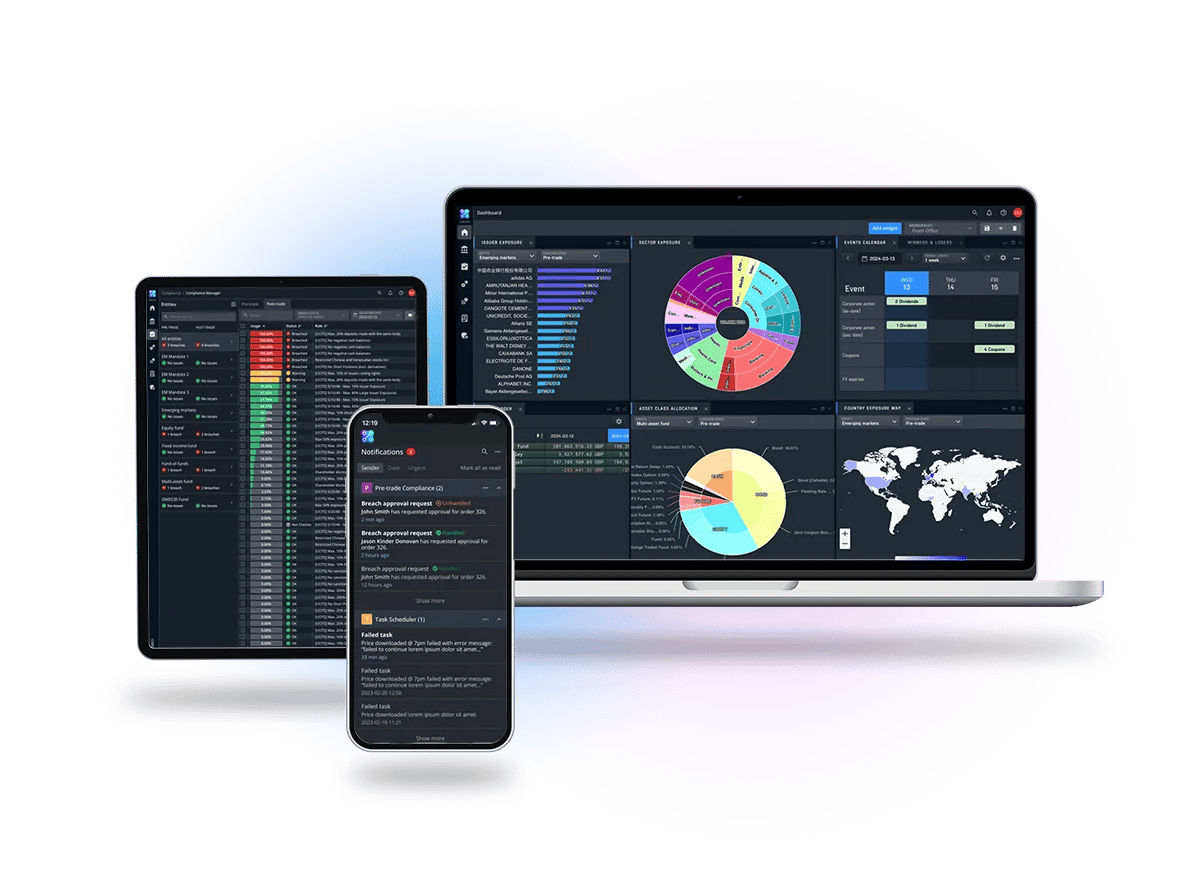






5 Equity Portfolio Management Tools Compared
The complete guide for equity managers evaluating modern investment management platforms
Your investment management system should accelerate workflows, not delay them.
The challenge: equity portfolios require instant access to accurate positions, real-time analytics, and rapid rebalancing capabilities. Yet many equity portfolio management platforms still rely on batch processing and overnight updates; creating operational bottlenecks that cost real money.
This guide shows you exactly how 5 platforms differ on what actually matters:
We analysed Limina IMS, BlackRock Aladdin, Charles River (CRIMS), SS&C Eze, and SimCorp One (rebranded from SimCorp Dimension) to answer the questions like:
- Which platforms update positions in real-time vs. overnight batch processing?
- What do implementations really take? (2-4 months for some, 12-18 months for others)
- Can you connect new brokers yourself in hours, or wait months for vendor projects?
- Who publishes transparent pricing vs. requiring enterprise negotiations?
The 5 factors that determine whether a platform accelerates or blocks your operations
1. Real-time data vs. yesterday's positions
The difference: Instant position updates vs. end-of-day batch processing
Why it matters: Real-time IBOR eliminates reconciliation work between systems. You make decisions on current data instead of yesterday's snapshots. Batch processing means your morning views don't reflect yesterday's closing trades.
Which platforms deliver: Limina and SimCorp are known for their native real-time IBORs.
2. Fast implementation vs. multi-year projects
The difference: 2-4 months vs. 12-18 months
Why it matters: Time to value. Limina can be operational in 2-4 months. SimCorp requires 12-18 months with specialised consultants. Vendor quotes assume perfect conditions, real implementations run longer.
Consider: Every month you wait is another month of operational inefficiency
3. Self-service integration vs. vendor dependency
The difference: Connect brokers in hours vs. wait months for professional services
Why it matters: When you find a better broker or need a new custody relationship, can you act immediately? Self-service tools (Limina's no-code integration) mean hours. Vendor-dependent means months of waiting and substantial fees.
Which platforms offer self-service: Only Limina provides true no-code self-service integration
4. Transparent pricing vs. hidden costs
The difference: Published pricing vs. enterprise negotiations
Why it matters: Only Limina publishes starting prices ($70K annually). Others require enterprise negotiations. But quoted licensing is just the start. Implementation fees, customisation charges, and integration projects often equal or exceed annual licensing. Total cost frequently runs 2-3x initial quotes.
Watch for: Infrastructure costs (on-premise systems), Terminal fees for all users, consultant fees (SimCorp, Aladdin, Charles River Development)
5. Automation that scales vs. manual workflows
The difference: Small teams managing tens or hundreds of portfolios vs. needing large teams just to manage simple rebalances.
Why it matters: Do you need to rebalance each portfolio manually, or can you handle 100 at once? Platforms with exception-based automation and multi-portfolio rebalancing let you scale without adding headcount. Manual workflows cap growth.
Which platforms automate: Limina's exception-based workflows, Charles River's compliance automation
Quick comparison: Equity Portfolio Management Tools
| Platform | Core Client AUM | Architecture | Implementation | Pricing Model | Self-Service Integration | Primary Strength |
| Limina IMS | $100M-$30B | Cloud-native | 2-6 months | Transparent ($70K onwards) | Yes (no-code) | Efficiency (Front Office & Operations) |
| BlackRock Aladdin | $30B+ | Cloud | 6-24 months | Custom | No | Risk analytics |
| Charles River | $10B+ | Hybrid cloud | 6-18 months | Custom | No | Compliance |
| SS&C Eze | <$5B | Cloud-enabled | 3-9 months | Custom | Limited | Execution |
| SimCorp | $5B+ | On-prem/Hybrid | 12-24 months | Custom | No | Customisation |
Key Finding: Implementation timelines and total cost of ownership vary dramatically. Cloud-native platforms like Limina deliver faster deployment and lower TCO, while legacy systems often require extensive customisation projects.
5 equity portfolio management platforms compared
1. Limina IMS: Modern architecture delivering measurable results
Core capabilities: Limina's cloud-native investment management platform delivers what growing asset managers actually need: real-time positions, automated workflows, and the ability to scale without adding headcount. Built specifically for modern investment management operations, it eliminates the operational drag that legacy systems create.
Standout equity features:
- True real-time IBOR: See position and cash changes instantly as trades execute, not minutes or hours later
- Exception-based workflows: Automates routine tasks, alerts only on anomalies. Clients report 50-70%+ reduction in operational time and for the Front Office
- Self-service integration: Connect new brokers/custodians in hours using no-code tools. No waiting months for vendor projects
- Multi-portfolio rebalancing: Handle funds and separately managed 60+ accounts (SMAs) simultaneously with live compliance and exposure checks
- Transparent, predictable pricing: Only platform with publicly listed pricing. No AUM penalties that punish growth
Pricing: Starts at $70K annually (transparent, publicly available pricing)
- 2-6 months to full production, fastest among comprehensive platforms
- Cloud-native means no IT infrastructure needed
- Automatic updates every 3 weeks
- Your team configures workflows themselves after initial training
Best suited for: Asset managers, asset owners and hedge funds who want institutional capabilities without enterprise complexity. Particularly strong for growing firms that need to scale operations efficiently.
2. BlackRock Aladdin: Enterprise risk and portfolio platform
Core capabilities: Combines portfolio management with sophisticated risk analytics.
Pricing: Contact for pricing
Equity Management Capabilities
- Advanced multi-factor risk models
- Sophisticated stress testing and scenario analysis
- Multi-asset portfolio management (equity plus other asset classes)
- Extensive performance attribution
- Integration with BlackRock's research ecosystem
Considerations for Equity Managers
Cost Structure: Implementations often need enterprise budgets, and require multiple months of customisation. Costs continue to climb as your AUM grows.
Implementation Complexity: Even straightforward equity workflows require extensive configuration. Most implementations need external consultants and dedicated internal resources.
When Aladdin Makes Sense: Large pension funds, sovereign wealth funds, and institutional asset managers with complex risk management requirements and substantial IT resources.
3. Charles River IMS: Compliance and order management focus
Core capabilities: Part of State Street's ecosystem. Strong emphasis on compliance and order management.
Pricing: Custom pricing based on AUM and users
Equity-specific features:
- Comprehensive pre-trade compliance
- Multi-broker order routing
- Integration with State Street services
Considerations for Equity Managers
Implementation Complexity: 6-18 month implementation timelines, on the shorter end when integrating with State Street services. May require dedicated project resources.
Heavy Integration Projects: Connecting to non-State Street systems can involve substantial technical work and vendor coordination.
When Charles River Makes Sense: Institutional managers with complex compliance requirements or existing State Street custody relationships. Strong fit for firms prioritising regulatory risk management.
4. SS&C Eze: Modular trading platform
Core capabilities: Offers separate modules for OMS, EMS, and portfolio accounting that can be implemented individually or together.
Pricing: Custom pricing based on modules and usage
Equity Capabilities
- Advanced order management and routing
- Real-time positions and P&L
- FIX connectivity and broker integration
Considerations for Investment Managers
- Implementation Complexity: Modular implementation allows 3-4 month deployment for core functionality, but full integration across modules requires attention to data synchronisation.
- Module Coordination: Managing data consistency between separate modules can create operational overhead if not carefully architected.
When SS&C Eze Makes Sense: Hedge funds and asset managers where execution quality is paramount. Strong fit for firms with active trading strategies requiring sophisticated order routing.
5. SimCorp One (previously SimCorp Dimension): Highly configurable platform
Core capabilities: Strong European presence. Offers extensive customisation capabilities.
Pricing: Contact for enterprise pricing
Equity-specific features:
- Complex corporate action handling
- Configurable workflows
- Comprehensive accounting
- Regulatory reporting across jurisdictions
Considerations for Investment Managers
- Cost Structure: Enterprise pricing with significant customisation costs. Implementation budgets reported to run into millions for large deployments.
- Implementation Complexity: Extensive configuration typically requires 12-18 months and specialised consultants. May need ongoing vendor support for changes.
- Resource Requirements: Deep customisation means you'll need dedicated internal resources familiar with SimCorp's architecture.
When SimCorp Makes Sense: Large pension funds, insurance companies, and asset managers with complex, unique operational requirements and resources for extensive customisation. Particularly strong in Europe.
The uncomfortable truth
Most firms know their current system isn't working but fear change more than inefficiency. They accept operational drag as "just how things are" while competitors using modern platforms capture more alpha with less resources.
The technology exists to transform equity portfolio operations. Platforms like Limina prove you can have sophisticated capabilities without enterprise complexity. The question isn't whether to upgrade, it's whether you'll do it before your competitors.
Ready to evaluate equity portfolio management platforms?
Test with your portfolios. Verify capabilities. Calculate ROI.
Analysis based on publicly available information and platform capabilities as of 2025.