


Exception-based workflows










The Complete Guide to Enterprise Investment Tracking Software for Institutional Investors in 2026
How do you track investments across multiple asset classes, custodians, and strategies in real-time while maintaining accurate books and records?
The answer lies in enterprise investment tracking platforms; comprehensive systems that serve as the single source of truth for portfolio positions, transactions, cash flows, and valuations.
The enterprise investment tracking market has undergone dramatic transformation. Cloud-native architecture has become the standard, with McKinsey reporting potential operational cost reductions of 20-30% through cloud migration. Real-time data processing is replacing overnight batch runs, enabling intraday position visibility that T+1 settlement demands. Front-to-back consolidation continues as firms abandon fragmented systems that require constant reconciliation.
This guide examines the leading enterprise investment tracking platforms serving institutional asset managers, pension funds, hedge funds, and insurance companies—evaluating how they handle the fundamental challenge of maintaining accurate, real-time investment records at scale.
What is Enterprise Investment Tracking?
Enterprise investment tracking encompasses the systems and processes that maintain a comprehensive, real-time record of an organisation's investment holdings. At its core, effective investment tracking must answer four fundamental questions:
- What do we own? Complete inventory of cash and positions across all asset classes and portfolios
- What is it worth? Current valuations updated throughout the trading day
- How did we get here? Complete transaction history with full audit trail
- Does it reconcile? Automated verification against custodians, administrators, and counterparties
The technology that powers this capability is the Investment Book of Record (IBOR) a unified data architecture that consolidates positions, transactions, cash, and corporate actions into a single source of truth accessible by portfolio managers, traders, operations teams, and compliance officers simultaneously.
The Evolution: From Batch to Real-Time
Legacy investment tracking systems operated on overnight batch processing cycles. Portfolio managers would see positions "as of yesterday's close," operations teams would spend mornings reconciling breaks, and by the time issues were identified, the market had already moved.
Modern enterprise platforms have fundamentally reimagined this model:
- 3rd Generation IBOR architectures provide "live-extract" capability, the ability to view portfolio positions in any state (with or without specific trades) at any point in time (past, present, or future) without waiting for batch processing. Portfolio managers can simulate "what-if" scenarios on current holdings, while operations teams see the data they need in real-time.
- Exception-based workflows eliminate the need to manually review every transaction. The system automatically validates trades, reconciles positions, monitors compliance, and surfaces only the anomalies requiring human attention. This shift from "check everything" to "investigate exceptions" can reduce operations time.
- Front-to-NAV cloud architectures ensure all users, regardless of role or location, access identical data from market open through close. This eliminates the reconciliation overhead between front-office and back-office systems that plagues traditional architectures.
The Leaders in Enterprise Investment Tracking
Limina: real-time tracking built for any scale
Overview
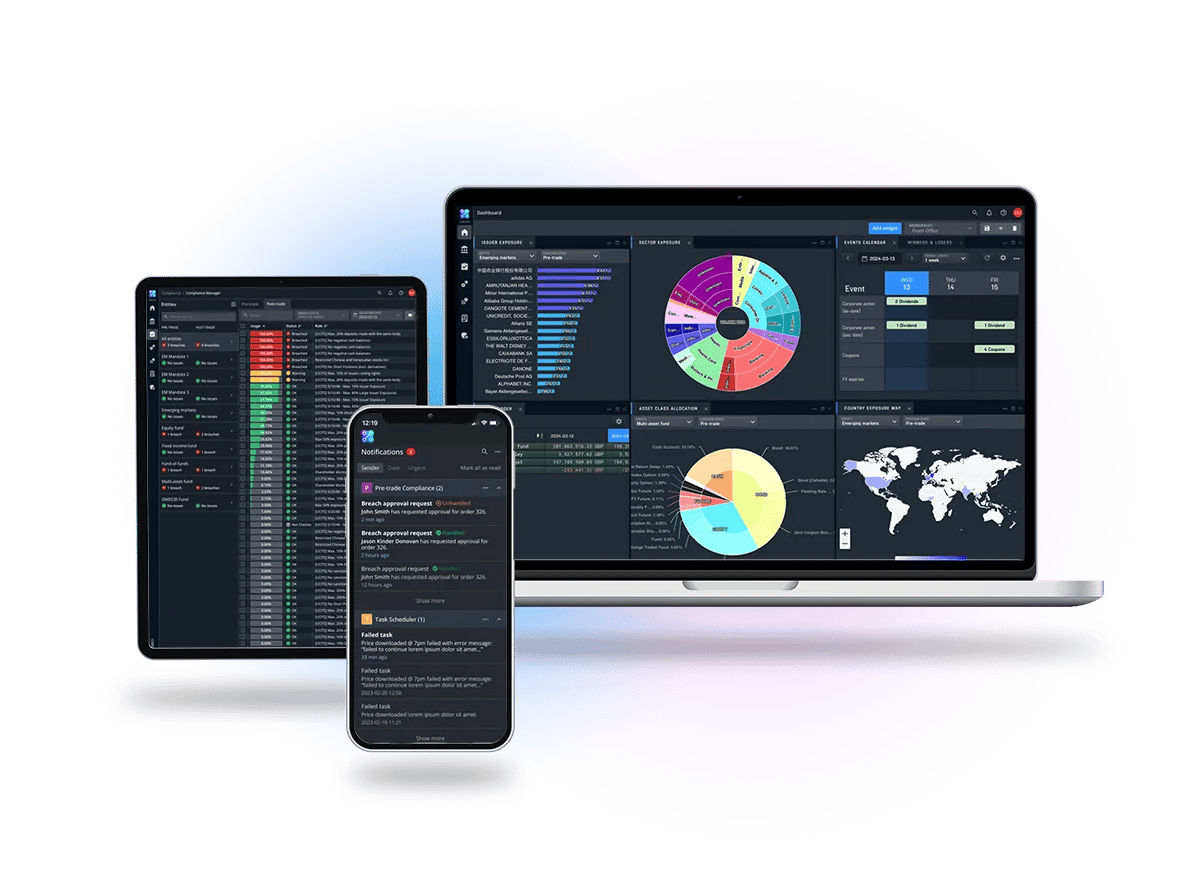
Founded in 2014 by former investment managers, Limina built one of only two systems with 3rd Generation "Live-Extract" IBOR capability in the market. The platform's transaction-based architecture enables portfolio managers to view cash and positions with or without specific trades applied, critical for pre-trade analysis and "what-if" rebalancing scenarios.
Target Market: Institutional investors from small and startup fund managers, to $10bn+ managers with ambitions to scale further.
Investment Tracking Capabilities:
- Real-time position visibility across all portfolios without batch processing delays
- Know what you’re looking at: automated reconciliation against custodians and fund administrators with exception-based workflows
- Multi-asset coverage spanning equities, fixed income, derivatives, FX, fund-of-funds and alternatives
- Corporate action visibility with automated lifecycle event tracking
- Complete cash ladder with both settlement and trade date views
Key Differentiator: No-code ETL tool allows operations teams to configure new custodian connections and any other data imports through drag-and-drop functionality, eliminating IT dependencies that create bottlenecks.
Transparent Pricing: Starting at approximately $70,000 annually, scaling based on users, funds, and transaction volume. This makes Limina the only enterprise vendor publishing pricing publicly.
Implementation: 3 weeks to 4 months with costs running as low as one-fifth of competitive solutions.
Best For: Mid-market institutional managers seeking modern investment tracking without enterprise complexity or cost.
BlackRock Aladdin: Risk-Adjusted Position Tracking at Scale
Aladdin manages approximately $21.6 trillion in assets (as of 2020), making it the industry's largest investment tracking platform. Originally built to power BlackRock's own operations, Aladdin's defining characteristic is risk-adjusted position tracking—every holding is continuously evaluated not just for current value but for risk exposure across a myriad of scenarios.
Example target market: Ultra-large institutional managers managing $50 billion or more
Investment Tracking Capabilities:
- AI-powered insights through Aladdin Copilot analysing position-level risk contributions
- Comprehensive position tracking: Real-time visibility across public and private markets with complete transaction history
- Multi-asset coverage: Full portfolio view integrating equities, fixed income, derivatives, and alternatives post eFront acquisition (2019, $1.3B) and Preqin acquisition (2025, $3.2B)
- Integrated exposure tracking: Position-level tracking includes factor exposures, credit spreads, duration, and currency
- Scenario position analysis: Track how portfolio positions would perform under various market conditions using Monte Carlo simulations
- Historical position reconstruction: Complete audit trail of position changes and valuation history
Technology Infrastructure: Runs on Microsoft Azure with data centres in Wenatchee, WA and other locations
Considerations: Implementation described as "building a small city" with 12-24+ month timelines. Reports cite a hefty price tag and comprehensive but inflexible architecture (limiting customisation).
Example fit for: Ultra-large institutions requiring enterprise-grade risk analytics integrated with position tracking.
SimCorp One: Front-to-Back IBOR Integration
Deutsche Börse's €3.9 billion acquisition of SimCorp in 2023 created an expansive investment management platform.
Example target market: Large institutions managing $20 billion+, particularly in Europe
Investment Tracking Capabilities:
- Unified IBOR architecture built as single system from inception (not assembled through acquisitions)
- Complex instrument support including exotic derivatives and structured products
- Multi-currency position tracking with sophisticated FX hedging workflows
- European regulatory reporting for UCITS, AIFMD, and other compliance requirements
Strategic Enhancements: November 2023 Axioma merger added sophisticated factor-based risk models and portfolio optimisation. Deutsche Börse integration provides access to Clearstream post-trade services, 360T FX execution, and ISS STOXX analytics.
Considerations: Traditional on-premise heritage means modernisation ongoing. Upgrades can be "time consuming and cost intensive" according to sources.
Example fit for: Large European institutions, insurance companies, and pension funds requiring deep accounting capabilities.
SS&C Technologies: Complex Instrument Tracking
SS&C's Geneva platform has achieved "gold standard" status for tracking complex alternative investments.
Example target market: Hedge funds managing $500 million+
Investment Tracking Capabilities:
- Complex structure support including master-feeder funds, multi-currency portfolios, and structured products
- Derivative position tracking with sophisticated Greeks calculation and margin management
- Multi-prime broker aggregation with automated trade matching and position reconciliation
- Investor-level position tracking with fee calculations and capital account management
Considerations: Acquisition-driven architecture creates integration challenges. The learning curve is steep for smaller firms.
Example fit for: Hedge funds requiring deep accounting capabilities.
Finbourne LUSID: Data-Centric, API-First Investment Data Platform
Finbourne Technology built LUSID (Liberated Unified Secure Investment Data-machine) as an API-first Investment Data Management System. Unlike traditional platforms that replace existing infrastructure, LUSID is designed for asset managers to unify, manage, and analyse investment data across the entire lifecycle (front, middle, back office).
Example target market: From startup fund managers to global institutions
Investment Tracking Capabilities:
- Multi-source position consolidation: Aggregate positions from multiple custodians, administrators, and internal systems
- Multi-asset position tracking: Equities, fixed income, derivatives, swaps, options, complex credit derivatives, private assets, alternatives
- User-definable instruments: Track custom or bespoke investment structures by defining their cash flow characteristics
- Real-time position visibility: API-first architecture enables instant position queries across all holdings
Pricing: Not publicly disclosed
Example fit for: Institutions requiring data infrastructure to support existing platforms, enable AI/ML initiatives, or consolidate disparate data sources without full system replacement.
Profidata XENTIS: Swiss Precision with 40 Years of Refinement
Profidata XENTIS is an integrated front-to-back investment management system that offers the full spectrum of requirements across portfolio and order management, investment compliance, risk monitoring, fund administration and accounting.
Example target market: European institutions managing $5 billion+
Investment Tracking Capabilities:
- Multi-asset coverage: equities, bonds, derivatives, structured products, private equity, private debt, real estate, crypto assets (via 2024 Boerse Stuttgart Digital partnership), hedge funds
- Look-through analysis capabilities for nested fund structures and complex derivatives
- Compliance engine with Rule Designer for dynamic rule creation, ESG screening, breach management
Pricing: Not publicly disclosed
Example fit for: European institutional investors prioritising stability, regulatory compliance (particularly Solvency II), and integrated front-to-back functionality with proven implementation methodology.
iborNAV by NAV-Secure: Emerging AI-Focused Platform
NAV-Secure positions itself as an AI-driven SaaS vendor offering iborNAV as a real-time Investment Book of Record dashboard.
iborNAV is designed to unify siloed position, cash, and trade data from disparate systems into a single source of investment truth. The platform is part of a six product suite including ctrlNAV (automated NAV oversight), esgNAV (ESG reporting and compliance), rptNAV (report management automation), +riskNAV (liquidity and derivative risk analytics), and xpnsNAV (fund expense oversight).
Example target market: Fund administrators, operations teams, portfolio managers, risk teams, and treasury teams managing multiple data sources
Investment Tracking Capabilities:
- Live Position Summary: Real-time portfolio holdings tracking with transparency by asset class, CUSIP, or trading desk
- Multi-Source Data Ingestion: Consolidates data from Excel, PDFs, FTP feeds, custodians, order management systems, and internal databases into unified dashboard
- Exception & Anomaly Alerts: Automated detection of reconciliation gaps, stale prices, and data mismatches
Pricing: Specific pricing not publicly disclosed
Example fit for: Investment operations teams seeking a lightweight IBOR dashboard to unify existing data sources without replacing core systems.
Critical Investment Tracking Capabilities to Evaluate
When selecting an enterprise investment tracking platform, assess these core capabilities:
1. Data Architecture: Batch vs. Real-Time
Legacy batch processing updates positions overnight.
Real-time IBOR updates positions throughout the day. Portfolio managers, traders, and operations teams see accurate and complete data from market open through close.
Questions to ask vendors:
- How frequently do position updates occur? (Intraday? Every 15 minutes? Real-time?)
- Can I view hypothetical positions with proposed trades applied before execution? Including the effect on cash ladder?
- Do all users see the same data simultaneously, or are there delays between systems?
2. Reconciliation Automation
Manual reconciliation between portfolio systems and custodian statements is time consuming for many managers, time that compounds when managing dozens of portfolios across multiple custodians.
Modern platforms automate position, cash, and transaction reconciliation, surfacing only the exceptions requiring investigation.
Questions to ask vendors:
- What percentage of reconciliation breaks require manual intervention?
- How long does it take to onboard a new custodian connection?
- Can non-technical users configure reconciliation rules, or does it require IT or the vendor?
3. Multi-Asset Coverage
Institutional portfolios increasingly span equities, fixed income, derivatives, private equity, real estate, and alternative investments. Fragmented tracking across multiple systems creates reconciliation nightmares.
Questions to ask vendors:
- How many systems do you need in order to cover investment tracking of all your portfolios?
- If you need more than one system, how will cash be possible to manage (since it’s centralised)?
- Can the system handle index products and fund-of-funds structures with look-through transparency?
4. Corporate Actions Processing
Stock splits, dividend payments, tender offers, and bond calls occur daily in large portfolios. Manual processing creates errors and operational risk.
Questions to ask vendors:
- Are corporate actions automatically identified and applied to positions?
- How are optional elections handled (e.g., stock vs. cash dividends)?
- What happens when corporate action data arrives late or requires correction?
- Can multiple sources of information be used for corporate action management?
5. Cash Management
Accurate cash position tracking prevents overdrafts, enables efficient cash deployment, and ensures proper accounting treatment.
Questions to ask vendors:
- Does the system provide forward-looking cash projections with both settlement and trade date perspectives?
- Can you track cash across multiple custodians, currencies and accounts in real-time?
Conclusion: Investment Tracking as Competitive Advantage
Enterprise investment tracking has evolved from back-office infrastructure to strategic capability. The technology landscape has reached an inflection point where real-time position visibility, automated reconciliation, and exception-based workflows are no longer exclusive to ultra-large institutions.
The question isn't whether to upgrade aging infrastructure, but which platform positions your firm for sustainable growth. Choose a solution that eliminates reconciliation overhead, provides real-time visibility, and enables your team to focus on generating returns for clients.
Sources & Additional Resources
Platform Resources:
- Limina IMS Platform
- BlackRock Aladdin
- SimCorp
- Charles River Development
- Clearwater Analytics
- Bloomberg AIM
- SS&C Technologies
Industry Research:
- McKinsey: Building a Cloud-Ready Operating Model
- Waters Technology Awards
- Institutional Investor Analysis
Key Acquisitions & Announcements:
This guide is based on publicly available information and industry sources as of December 2025. Features, pricing, and capabilities may change. Organisations should conduct thorough due diligence and request current information directly from vendors.