
Skip to content
HeroOfficeBackground-1

Maia Competitor Analysis and Alternatives

Maia is a proven investment technology system focused on data integration, analytics and portfolio intelligence for asset managers and investment teams, as it is a spinout of internal tech from Fulcrum Asset Management. However, many firms now evaluate broader, front-to-back alternatives as they look to reduce operational complexity, improve data quality and gain greater flexibility across their investment operations. This page compares Maia with Limina’s cloud-native Investment Management Platform to help investment teams assess key differences and determine which solution best supports their operating model.

Note: Vendor information here is based on company websites, industry publications and online review sites such as G2, Gartner, TrustRadius and Capterra. Such pages have been reviewed in January 2026 as a basis for this article.

A modern alternative

Why clients opt for Limina
Change management2
Increased Automation

Automated workflows reduce manual processing across the investment lifecycle. This improves data consistency, lowers operational risk and accelerates day-to-day execution.
Limina IMS usage stats - light bg - PMs
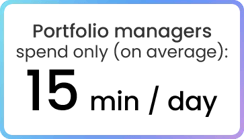
More Time for Investing

By reducing operational overhead and manual checks, investment professionals spend less time fixing issues and more time focused on portfolio decisions.

broken_chain
No Vendor Dependence

Self-service configuration removes the need for vendor-led changes. Teams can adapt workflows, data and rules quickly without waiting on external resources.

 

Quote background blue - wide

What clients are saying

AvanzaAsset management arm of a regional retail bank

By adopting Limina's scalable platform, Avanza has launched 33% additional funds without having to scale its investment operations team. They achieved:

  • Decreased dependency on single individuals - by replacing spreadsheets
  • Improved operational efficiency - by increased automation
AtleBoutique asset manager
  • "It’s such a modern portfolio management system – not only because it’s cloud-based, but the entire process flow and information I get is complete and up to date. It’s simple to use, flexible to work with, and it minimises the time for the entire trade workflow." / Portfolio Manager
  • "Limina helps us reduce operational risks." / CEO

What makes Limina different?

Designed for institutional investment managers

Limina is purpose-built for the complexity, scale and governance requirements of institutional asset managers, focusing on one holistic platform covering more than the minimum requirements of a front-to-back.

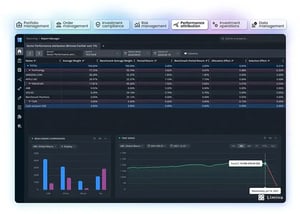
  • Native support for performance measurement and multi-level attribution across strategies, funds and mandates
  • True multi-portfolio architecture designed for teams managing hundreds of portfolios concurrently
  • Advanced portfolio modelling and scenario analysis to support investment decision-making, not just reporting
  • Built to align front office, investment operations and oversight functions in one investment management platform
Performance attribution

All workflows and assets in one system

Limina replaces fragmented tools and spreadsheets with a single, unified investment platform that spans the full investment lifecycle.

  • One source of truth for portfolios, positions, transactions, benchmarks and analytics
  • Integrated workflows across portfolio management, performance, reporting and oversight
  • Eliminate data hand-offs, reconciliations and duplicated processes between systems
  • Consistent data, calculations and controls across every user, team and workflows
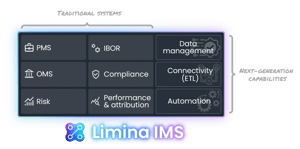
Limina's Investment Management Solution combines the workflows you need with powerful data & automation capabilities in one solution

Connect to anything and anyone

Limina is designed to fit into your existing ecosystem, enabling seamless connectivity across vendors, counterparties and internal teams.

  • Open architecture with APIs and data connectors for custodians, accounting systems, risk providers and data vendors
  • Flexible integration model that supports existing operating models rather than forcing change
  • Secure collaboration across internal teams, external managers and service providers
  • Future-proof connectivity that evolves as your technology landscape changes

Connectivity files and computer

Built for true self-service

Limina empowers investment teams to move faster by putting control directly in the hands of users, without reliance on IT or vendors.

  • Configure portfolios, analytics, views and reports without technical dependency
  • Rapid onboarding of new strategies, mandates and asset classes
  • Users can adapt the platform as investment processes evolve
  • Reduced operational friction, faster insights and lower total cost of ownership

Dont wait for vendors
Lower Total Cost of Ownership (TCO)

Efficient upgrades, integrations & changes save you money
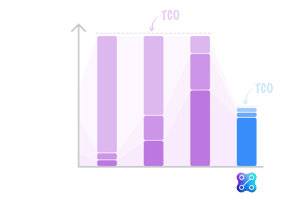
TCO alternatives

See the next market leader in action

If you're looking to get ahead, and stay ahead, why not schedule a no obligation demo with us at a time to suit you?
FAQ2

Any questions?

Check out the answers to some of the most frequently asked questions about Limina IMS!

Choosing Between Maia and Flexible Modern Investment Management Platforms

Selecting the right investment management platform requires more than comparing feature lists or technical specifications. It involves understanding how a platform’s architecture, data model and operating philosophy align with the way your investment organisation works today, and how it will need to evolve in the future. Maia is a modern, cloud native investment management platform positioned to serve institutional asset managers, hedge funds and alternative investment firms seeking a unified front to back solution.

As firms reassess legacy technology stacks and look to modernise their operating models, Maia is often evaluated alongside other contemporary platforms to determine whether its real time architecture, integration capabilities and workflow coverage meet long term operational and governance requirements. In parallel, solutions such as Limina’s Investment Management Solution are frequently considered by organisations prioritising transparency, self service configuration and flexibility across investment and operational teams. The sections below outline the key considerations for firms assessing Maia and how its approach compares with alternative modern platforms.

Understanding Maia’s core proposition

Maia is a cloud native investment management platform designed for institutional asset managers, hedge funds and alternative investment firms. Built on an open architecture, it is a spinout of internal tech from Fulcrum Asset Management. Maia emphasises flexibility, scalability and deep integration across workflows. The platform delivers portfolio management, real time investment book of record, order and execution management, compliance, risk and post trade processing through a single, unified system footprint. Its API first approach and fluent integration layers aim to give users programmatic control over data, events and workflows, supporting high volume trading and real time analytics across multi asset strategies.

Maia’s cloud native design means it is delivered as SaaS with managed upgrades and delivery, intended to reduce technical debt and allow firms to focus on investment outcomes rather than infrastructure. The platform provides pre configured workflows for common investment processes that can be tailored to individual operating models. By comparison, platforms such as Limina’s give organisations a modern foundation that combines workflow integration with enterprise data and governance control.

Connectivity and real time processing

One of Maia’s defining features is its cloud native architecture combined with an API centric integration model. The platform uses an event driven approach rather than periodic batch processing, which allows for real time updates to positions, trades and cash balances within its investment book of record. Bi-directional APIs support multiple programming languages, enabling direct interaction with data and workflows across the system.

This approach represents a shift away from traditional legacy systems that rely on slower refresh cycles and delayed visibility, aiming instead to provide investment teams with greater transparency and control. For organisations that value direct, programmable access to workflows and system logic, Maia’s model supports automation, bespoke analytics, systematic strategies and custom integrations. For firms prioritising real time connectivity, this architecture reduces delays, enables automation across the investment stack and facilitates seamless integration with internal systems, external data providers and counterparties.

By contrast, platforms such as Limina’s investment management system also emphasise strong connectivity and data integration, but place greater focus on enterprise grade workflow design and configuration by business users.

Front to back workflow support

Maia is positioned as an end to end platform spanning front, middle and back office functions. It provides capabilities covering portfolio construction and modelling, trade generation and execution, compliance monitoring, risk analysis, reconciliation and reporting. The integrated nature of the platform is designed to reduce the need for multiple systems and manual hand offs that can introduce operational risk.

For firms operating multi strategy and multi asset portfolios, this breadth of functionality can help centralise operations and improve straight through processing. However, organisations should consider how accessible and configurable these workflows are for day to day users. In contrast, platforms like Limina integrate portfolio analytics and performance attribution directly into self service workflows designed for investment professionals rather than operational specialists. Limina’s strength in portfolio modelling and portfolio tracking software mechanics further highlights how front office needs can be met without fragmentation across disparate systems.

Supporting growth and complexity

Maia positions itself as a platform that can scale alongside growing and increasingly complex investment organisations. Its cloud infrastructure and modular workflows are intended to support expanding asset class coverage, higher transaction volumes and evolving regulatory requirements. Managed SaaS delivery reduces the burden of platform maintenance and upgrades.

When evaluating Maia, firms should assess how its operating model aligns with their internal capabilities, particularly around configuration, change management and long term ownership. While Maia’s API driven approach can suit organisations with strong technical resources, platforms such as Limina’s IMS emphasise rapid self service configuration and adaptability by business users, supporting faster change without extensive development effort through a structured implementation process.


IBOR standards and disclosure

Maia includes an Investment Book of Record (IBOR) as a core component of its platform, providing real time visibility into positions, trades and cash balances. However, publicly available information does not indicate whether Maia’s IBOR adheres to the 2014 Global Investment Performance Standards related to IBOR data definitions, governance controls or calculation methodologies. Organisations assessing Maia would need to engage directly with Maia Technologies to understand how their IBOR supports the data quality, auditability and calculation requirements set out in the standard.

This differs from Limina’s open and transparent approach to IBOR design, where data models, cash position management and governance principles are clearly documented through Limina’s IBOR and cash position management and Investment Book of Record.

For firms where IBOR transparency and standard alignment are critical, this distinction can be an important consideration during platform selection.

Assessing Maia alongside modern alternatives

Maia represents a modern investment management platform designed to replace legacy systems through cloud native delivery, real time processing and broad workflow coverage. Its strengths lie in its architectural design and integration capabilities, particularly for firms prioritising automation and technical flexibility.

As with any institutional platform, organisations should carefully evaluate how Maia’s approach aligns with their operating model, governance expectations and user needs. Comparing Maia with platforms such as Limina helps highlight differences in transparency, configurability and usability, enabling firms to select the solution that best supports long term efficiency and control. Limina’s breadth of capability, from core workflow integration through to detailed operational support such as investment operations, underscores an alternative model focused on configurability by business teams rather than through engineering dependencies.

Show more