


Exception-based workflows










Beyond Spreadsheets: A Guide to Professional Portfolio Modeling Software
If you're a professional in the investment world, you know the humble spreadsheet is the starting point for... well, just about everything. But you also know its limits. When it comes to rigorously backtesting a new multi-asset strategy, running "what-if" scenarios for a set of managed accounts, or stress-testing a billion-dollar portfolio against a 2008-style crisis, Excel simply can't keep up.
This is where portfolio modeling software comes in. This isn't just "portfolio management" software, which often focuses on tracking current accounts, rebalancing, and performance reporting.
Portfolio modeling software is about designing, simulating, and analyzing portfolio risk and composition—answering questions like "What is my factor exposure?" or "How would this allocation perform in a recession?"—rather than deploying pre-built model portfolios to client accounts.
These tools allow advisors and institutional managers to:
- Backtest Strategies: See how a model would have performed over years of market history.
- Run Simulations: Use Monte Carlo analysis to model thousands of possible future outcomes.
- Stress Test: Answer questions like, "What happens to this portfolio if interest rates jump 3%?"
- Analyze Risk: Go beyond simple volatility (standard deviation) to understand complex factor exposures, downside risk (drawdowns), and correlations.
- Communicate Value: Visually and empirically show a client or investment committee why your proposed strategy is superior to their current one.
This guide breaks down the top professional-grade portfolio modeling software engineered for Institutional/Enterprise use.
Note: the information on this page is a consolidation of information available elsewhere online, on the sources cited herein as per November 2025.
A Note on Terminology
This guide focuses on portfolio modeling software; tools for analyzing risk, simulating scenarios, and optimizing portfolio composition. This is distinct from "model portfolio management" platforms, which are used to create, distribute, and rebalance pre-built portfolio templates (like "Conservative Growth" or "Aggressive Equity" models) across multiple client accounts.
While some platforms offer both capabilities, our focus here is on the analytical and risk modeling functions that help investment professionals design and test portfolio strategies, not the operational tools for deploying standardized model portfolios at scale.
Comparison of Top Portfolio Modeling Tools
Here is a high-level look at the solutions we'll cover, their primary user, and what makes them unique.
To streamline decision-making, the table below benchmarks these tools across critical dimensions. Data draws from vendor specs, user benchmarks [G2, Capterra]
| Tool | Core Strength | Asset Class Considerations | Client segments include | Pricing | Implementation time examples found online | Scalability examples (AUM Fit) |
| Limina IMS | Front-to-back automation & simulation | Multi-asset (incl. alts) | Mid-Sized Investment Managers | $70K–$400K / year (usage-based) | 1-6 months | $100M–$30B |
| BlackRock Aladdin | Enterprise lifecycle mgmt. | Public/private multi | Global Asset Managers | Custom | 6–18 months | Large enterprise scale (e.g. $10bn+) |
| Addepar | Illiquid asset aggregation | Wealth portfolios (incl. privates) | Family Offices & UHNW | Custom | 2-4 months | UHNW, e.g. $500M+ |
| MSCI Barra PM | Equity factor risk forecasting | Strengths in global equities | Risk & Quant Teams | Custom | 2-3 months | For example $1B+ institutional |
| Confluence (StatPro Revolution) | Visual performance attribution | Multi-asset | Diverse | $100–$500/portfolio / month | 1-2 months | Varying. Mentions of ~$1B & RIAs |
This matrix reveals patterns: Nimble tools like Limina prioritize speed for growth firms, while behemoths like Aladdin demand patience for unmatched depth.
Navigating Portfolio Modeling Software: Essential Tools for Modern Investors
- Core Value: Portfolio modeling software empowers investors to simulate scenarios, optimize allocations, and mitigate risks using data-driven insights, with 2025 trends emphasizing AI integration and private asset handling to navigate market conditions.
- Top Picks: Limina IMS suits scalable mid-tier firms looking for low system complexity; MSCI Barra excels in equity factor risk; StatPro Revolution prioritizes visual analytics; Addepar handles complex wealth structures; BlackRock Aladdin dominates in enterprise-scale investment managers.
- Selection Tip: Choose based on AUM size and asset complexity—smaller firms benefit from an all-in-one option like Limina, while institutions might lean toward the breadth of a best-of-breed option.
What Is Portfolio Modeling Software?
At its heart, portfolio modeling software is a suite of features in a software (on-premise or Software-as-a-Service) that allows financial professionals to analyze portfolio risk, test composition strategies, and simulate market scenarios. These platforms focus on risk decomposition (understanding why a portfolio behaves as it does), forward-looking simulations (Monte Carlo, stress testing), and optimization (finding the best allocation for specific constraints).
This is fundamentally different from "model portfolio management" systems, which handle the operational workflow of assigning pre-built portfolio templates to client accounts and rebalancing them at scale. The tools reviewed here emphasize analytical depth—helping you understand and design portfolios—rather than operational efficiency in deploying standardized models. However, Limina excels at the latter (model portfolio management).
Why Portfolio Modeling Software Matters in 2025
In an era of geopolitical tensions and asset re-allocations, these platforms are indispensable for invest analysis and alpha generation. AI enhancements, such as predictive modeling in Aladdin, are reducing manual efforts, while cloud-based deployments cut setup times from months to weeks and decrease total system costs dramatically.
Selecting the right tool can mean the difference between reactive firefighting and strategic foresight.
Detailed Overview of Leading Portfolio Modeling Software
Limina IMS: Streamlined Automation for Agile Managers
- A modern, cloud-native Investment Management System (IMS) for mid-sized asset managers. It's designed to be a complete front-to-mid solution for investment managers, replacing the "stitched-together" patchwork of old systems.
- Limina IMS redefines portfolio modeling as a seamless, cloud-native ecosystem, blending front-office ideation with execution and post-trade processing through a single Investment Book of Record (IBOR).
- Launched in 2014 by ex-investment management professionals, it processes position and cash data in real-time, allowing users to simulate portfolio changes across 300+ metrics—like exposures and duration—without data silos.
Core to its appeal
- A no-code rule builder for compliance, and ETL pipelines that ingest custodian feeds in minutes, slashing reconciliation time and lag.
- Web-based access in a delightful user interface.
Core Capabilities:
- Unified Platform: Combines Portfolio Management (PMS), Order Management (OMS), and Compliance in one system with a "3rd Gen IBOR."
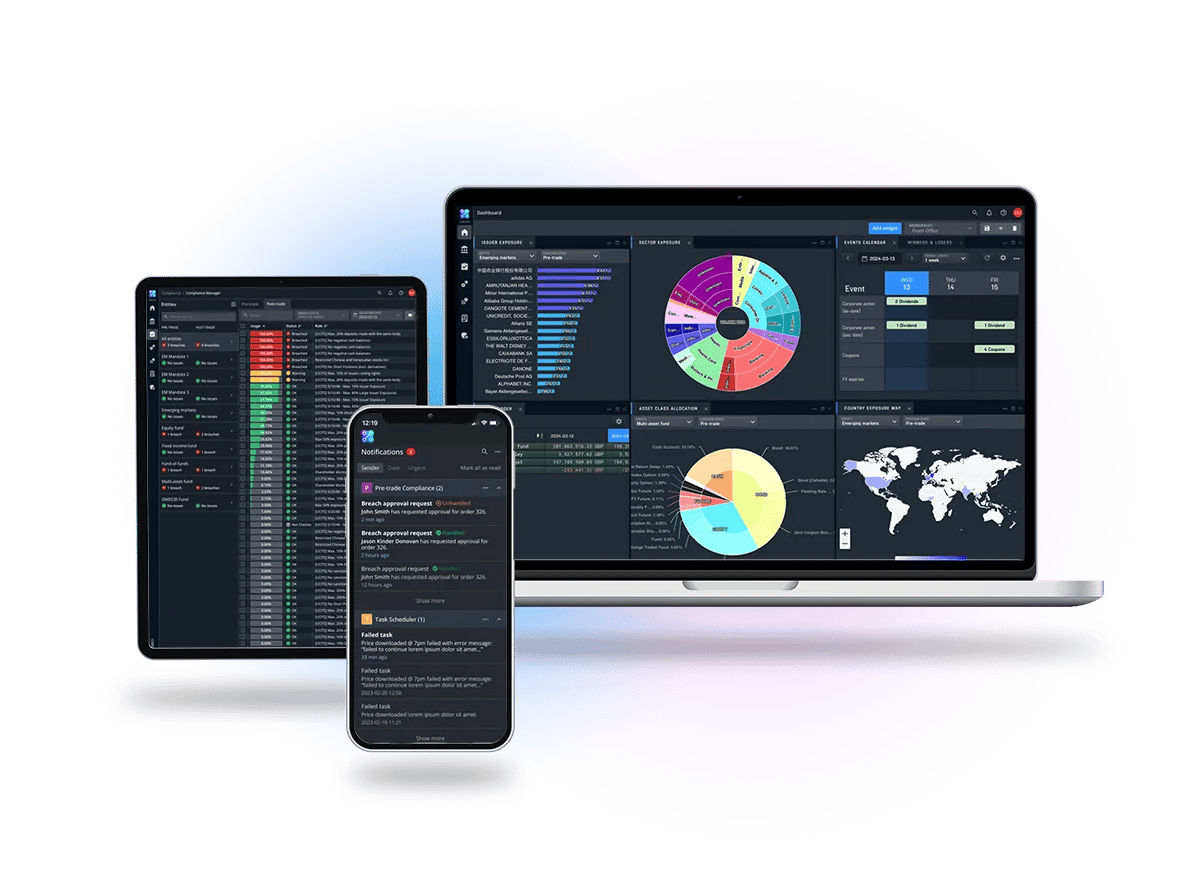
- Live Portfolio Modeling: Allows PMs to model "what-if" scenarios, run rebalances, and check pre-trade compliance in real-time with live data.
- Exception-Based Workflows: Built to automate operational tasks (like reconciliations and data validations) and only alert users when an exception occurs.

- Expanded Capabilities: Beyond basics, Limina's simulation engine forecasts forward-looking impacts, such as "10% increase in allocation to investment grade bonds affect our overall portfolio duration?" It supports Brinson-Fachler attribution on transaction-level data, enabling forensic breakdowns of alpha sources.
- Pricing:
- It is positioned as a more agile and cost-effective alternative to legacy giants.
- Transparent tiers start at $70K for basics, scaling to $400K for high-volume ($30B AUM), avoiding AUM-based gouging: a rarity.
Implementation Advantage: Go-live in 4–8 weeks possible with self-service connectors; no IT army required, unlike legacy rivals.
Best Suited For: Mid-sized asset managers ($100M–$30B AUM) craving end-to-end efficiency without enterprise bloat.
Limina IMS
- Official pricing page: https://www.limina.com/pricing (confirms $70K-$400K range)
- Implementation timeline: https://www.limina.com/implementation-process (official timeline documentation)
- Platform overview: https://www.limina.com/platform (technical capabilities)
- TrustRadius Pricing Insights
BlackRock Aladdin: The Institutional Nervous System
"Aladdin" (an acronym for Asset, Liability, and Debt and Derivative Investment Network) is one of the world's most comprehensive and well-known investment management platforms. It unifies the entire investment process—from modeling and trading to risk and operations—on a single system.
- Core Capabilities:
- "Whole Portfolio" View: Its main promise. It provides a single, real-time Investment Book of Record (IBOR) for all assets, public and private, across the entire firm.
- Enterprise Risk: Runs sophisticated risk analytics, factor modeling, and stress tests across the organization's entire AUM.
- Full Lifecycle Management: Handles everything from pre-trade compliance and order execution to post-trade operations.
- Pricing: Enterprise-level contract. Pricing is not public but it is often billed based on a percentage of AUM according to online reports.
- Implementation Advantage: The advantage is its all-in-one nature, which eliminates data silos.
- Best Suited For: Large, global asset managers, pension funds, and insurance companies that need a single, unified platform to manage hundreds of billions or trillions in AUM.
BlackRock Aladdin
- Wikipedia page: https://en.wikipedia.org/wiki/Aladdin_(BlackRock)
- Official Aladdin site: https://www.blackrock.com/aladdin
- Implementation case study: https://alphafmc.com/blog/2025/03/26/accelerated-aladdin-technology-delivery-debunking-perceptions-of-enterprise-transformation
Addepar: Unraveling Complexity in Wealth Ecosystems
A modern, cloud-native platform built to solve the single biggest problem for family offices and UHNW wealth managers: data aggregation and modeling for complex, alternative assets.
- Core Capabilities:
- Data Aggregation: Its "killer feature." It excels at ingesting, normalizing, and modeling data from any source, including illiquid assets like private equity, hedge funds, real estate, and even art.
- Complex Ownership Modeling: Can model intricate legal structures (trusts, LPs, holding companies) to give a true "whole portfolio" view for a wealthy family.
- Navigator Tool: A forward-looking modeling tool for running "what-if" scenarios and projecting cash flows (essential for e.g. private equity investments).
- Pricing: Enterprise-level "Contact Sales" model.
- Implementation Advantage: 2–4 months reported with 100+ integrations. It is API-first and cloud-native, making it seamless to connect to other systems.
- Best Suited For: Multi-family offices, single-family offices, and private banks managing UHNW client portfolios with significant alternative asset holdings.
Addepar
- Wikipedia page: https://en.wikipedia.org/wiki/Addepar
- Company history/analysis: https://research.contrary.com/company/addepar
- Alternative investments: https://addepar.com/blog/managing-alternative-investments-in-a-changing-landscape
- Private banking solutions: https://addepar.com/private-bank
- Reddit Addepar Pricing Discussion
MSCI Barra Portfolio Manager: Precision Risk for Equity Powerhouses
This one is different. MSCI Barra is not a "platform" in the same sense as Limina, Aladdin and Addepar. It is however the gold-standard when it comes to equity and multi-asset class risk models. Other platforms either use MSCI Barra models in their product, or send portfolio data to MSCI Barra for best-of-breed functionoality performed using Barra.
MSCI's Barra Portfolio Manager, evolved from 40 years of factor research, is often considered the top choice for equity-centric modeling, leveraging a cloud-based interface to dissect portfolios via 50+ risk factors (e.g., momentum, value).
- Core Capabilities:
- Factor Risk Decomposition: Its core function. It allows you to decompose a portfolio's risk into specific, understandable factors (e.g., Value, Growth, Momentum, Volatility, and industry factors).
- Risk Forecasting: Provides risk forecasts (e.g., predicted tracking error, VaR) based on these sophisticated models.
- Pricing: Institutional license. Requires "Contact Sales."
- Implementation Advantage:
- It is the industry standard. Its "language" of risk is understood by asset owners and managers globally, making it a "must-have" for many institutional managers.
- Example timelines include 3-4 months via cloud, with minimal hardware
- Best Suited For: Quantitative portfolio managers, risk management teams, and large asset owners who need to deeply understand, model, and report on factor-driven risks.
MSCI Barra Portfolio Manager
- LSEG/Refinitiv models page: https://www.lseg.com/en/data-analytics/financial-data/company-data/quantitative-models/msci-barra-models
Confluence (formerly StatPro): Visual Storytelling for Performance Pros
StatPro was a well-known provider of cloud-based portfolio analytics, which was acquired by Confluence. The platform is less a "modeling" tool and more a "performance and attribution" reporting engine.
- Core Capabilities:
- Performance & Attribution: Its core strength is in performance measurement, GIPS compliance, and attribution reporting for client and regulatory needs (Source: Confluence.com).
- Cloud-Based Reporting: Provides daily performance, contribution, and risk analytics via a web-based solution.
- Pricing: Enterprise "Contact Sales" model.
- Implementation Advantage: As a cloud solution, it provides sophisticated analytics and reporting without a heavy IT footprint. For pre-integrated source systems (e.g. Order Management Systems), it has been reported possible to implement within a month.
- Best Suited For: Asset managers, fund administrators, and asset servicers who need a scalable, cloud-based solution for performance, risk, and regulatory reporting.
StatPro Revolution/Confluence
- Acquisition history: https://www.confluence.com/about/statpro-history (October 2019 acquisition details)
- Pricing: https://www.investmentnews.com/industry-news/news/accessing-big-gun-analytics-38582
- Target market: https://www.proactiveinvestors.co.uk/companies/news/25657/statpro-building-a-solid-pipeline-of-business-for-new-revolution-product-30621.html
- GIPS compliance: https://www.risk.net/awards/7230256/performance-attribution-product-of-the-year-statpro
- Capterra: StatPro Reviews
- StatPro Revolution via Confluence
- SoftwareSuggest: StatPro Features
Making Your Selection
Your choice ultimately depends on three factors:
- Scale & Complexity: Smaller and mid sized investment managers benefit from agile, quick-deploy solutions like Limina that deliver enterprise functionality at a fraction of the cost. Global institutions managing $100B+ are more likely to require Aladdin's comprehensive ecosystem despite considerations such as implementation.
- Asset Focus: Equity-centric managers could consider MSCI Barra's factor models, but then also need a system such as Limina to complement with other functionality. Family offices with significant alternatives need Addepar's expertise in illiquid asset aggregation. Multi-asset managers require platforms like Limina or Aladdin that handle everything seamlessly.
- Implementation Reality: Be honest about your resources. Try to get an honest assessment of the resource needs to implement the given solution. It doesn't matter how great the software is if the implementation project fails.
The Bottom Line
Portfolio modeling software isn't just about better analytics; it's about transforming how your firm competes. The right platform turns data into decisions, complexity into clarity, and constraints into opportunities. Whether you're optimizing a $100 million emerging market equity portfolio or stress-testing a $50 billion multi-asset multi-portfolio structure, these tools are no longer optional: they're essential for survival and success.
Start with a clear assessment of your needs, test with real scenarios, and choose a partner that can grow with your ambitions. The investment you make in portfolio modeling capabilities today will define your competitive position tomorrow.
Other references
Ready to evaluate equity portfolio management platforms?
Test with your portfolios. Verify capabilities. Calculate ROI.
Analysis based on publicly available information and platform capabilities as of 2025.