
Charles River Development - Competitors & Alternatives
Charles River IMS (Investment Management Solution) is a long-established front-to-back investment management platform used by asset managers, asset owners and wealth managers requiring portfolio management, order management, compliance and post trade processing within a unified system. However, as expectations shift towards cloud native architecture, real time data consolidation and automated workflows, many firms are reassessing whether traditional enterprise platforms provide the flexibility and operational efficiency now required. This page compares Charles River IMS with Limina’s cloud native Investment Management System to help investment teams evaluate key differences and determine which solution best supports their operating model.
Note: Vendor information here is based on company websites, industry publications and online review sites such as G2, Gartner, TrustRadius and Capterra. Such pages have been reviewed in March 2026 as a basis for this article.
Why clients opt for Limina

4.9/5 rating by end users.
Slick and effective workflows for Portfolio Managers and Traders.

Managed upgrades that adhere to highest governance requirements of large managers. Become nimble through quick release cycles and self-service features.

98% of investment managers don't have exception-based workflows. 56% have incomplete or unreliable integrations. Not with Limina.

What clients are saying
By adopting Limina's scalable platform, Avanza has launched 33% additional funds without having to scale its investment operations team. They achieved:
- Decreased dependency on single individuals - by replacing spreadsheets
- Improved operational efficiency - by increased automation
Genesis moved to Limina and achieved the benefits of a cloud-native environment (keeping governance & oversight intact):
- Lower IT costs
- Simpler BCP processes
- More efficient operations
What makes Limina different?
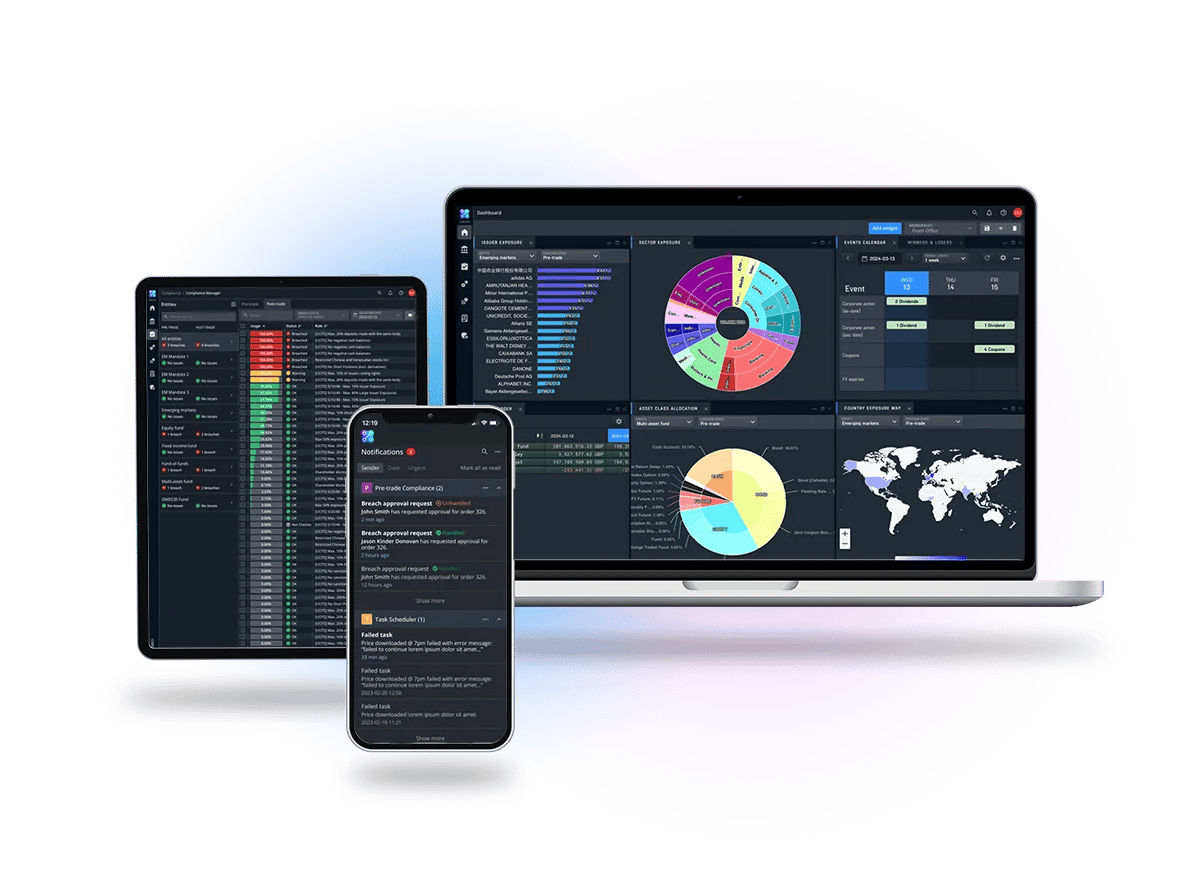
Modern user experience
- Full-feature access from browser and tablet
- Native mobile app
- Slick & efficient workflows
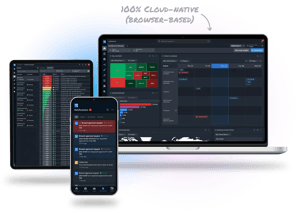
Cloud-native (and enterprise)
- Managed & frequent upgrades
(that still adhere to the highest level of governance requirements) - No IT-footprint and no system admin required
- Suitable for enterprise requirements. Your data is isolated (not mixed with other clients) and the microservice architecture allows for scalability

Connect to anything & anyone
Greatly reduce the time spent on manual data input and extracts with Limina's powerful connectivity:
- Standard connectivity to the most popular data & service providers
- Easily build, schedule and maintain your own custom integrations in minutes to anywhere: custodians, internal tools, data warehouses, admins, and more

All workflows centralised & connected externally
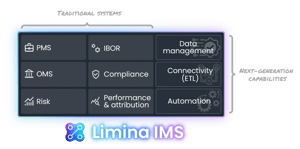
All workflows & asset classes in one system - combined in one solution with powerful automation capabilities & built-in data controls.
Easily build, schedule and maintain your own custom integrations in minutes to anywhere: custodians, internal tools, data warehouses, admins, and more.
Partnership approach
We come from the buy-side, have been in your shoes and knows what you want from a vendor beyond a system:
- Dedicated service, by a team that knows your setup and your portfolios
- Ability to influence roadmap and get your requirements prioritised
- Direct access to our product management team, regardless of your company size

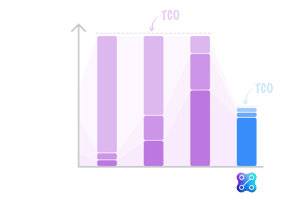
Efficient upgrades, integrations & changes save you money
See the next market leader in action
If you're looking to get ahead, and stay ahead, why not schedule a no obligation demo with us at a time to suit you?Charles River IMS: Platform Capabilities, Architecture and Strategic Fit
- 01 Operational Coverage
- 02 Architecture and Deployment
- 03 Implementation Model
- 04 Data, Analytics and Risk
- 05 Integration Strategy
- 06 Target Market Fit
- 07 Summary
Unified Investment Operations Across Front, Middle and Back Office
Charles River IMS delivers broad functional coverage across order management, portfolio construction, risk analytics, compliance monitoring and post trade workflows. Its unified data platform is designed to ensure consistency and control across investment activities, enabling firms to manage execution, positions, performance and reporting from a consolidated environment.
For organisations with complex mandates and multi asset strategies, this depth of coverage can enhance operational control and reduce fragmentation between systems. However, tightly integrated enterprise platforms may introduce rigidity in workflow customisation and third-party integration. When considering a Charles River IMS alternative, you should assess how effectively a platform supports workflow transparency, real-time processing and extension to new data sources without heavy custom development.
Systems such as Limina’s Order Management System embed compliance and exposure checks directly into real-time trade lifecycles, enabling you to execute decisions with fewer operational bottlenecks and clearer audit trails.
Enterprise Data Model, Scalability and Cloud Evolution
Charles River IMS has evolved over decades, incorporating a unified data model that underpins trading, risk and portfolio functions. The platform supports both licensed and managed hosting models, providing scalability and security for global investment operations.
Architecture significantly influences upgrade cadence, implementation timelines and ongoing system management. Modern cloud native investment platforms are designed with continuous deployment models and browser-based access, reducing reliance on heavy infrastructure oversight and periodic upgrades. With Limina’s cloud native platform and its Investment Book of Record, positions, transactions and exposures are consolidated in real-time, supporting portfolio oversight and analytics without batch dependencies.
When evaluating Charles River IMS competitors, architecture often determines your firm’s ability to innovate, scale and adapt to changing regulatory and market requirements.
Implementation Complexity, Upgrade Cycles and Change Governance
Charles River IMS implementations are typically structured enterprise projects involving configuration, integration and data migration across multiple workflows. Given the platform’s breadth of functionality and unified data architecture, implementation scope can extend beyond trading and portfolio management into accounting, compliance and reporting layers. For large organisations, this depth can support comprehensive operational consolidation, but it often requires structured project governance and dedicated internal resources.
Upgrade management and system evolution also form part of the long-term operational model. Enterprise platforms with deep configuration layers may require coordinated release planning, regression testing and change management oversight. When evaluating a Charles River IMS alternative, you should consider how implementation timelines, upgrade cadence and internal resourcing requirements align with your organisation’s appetite for change and operational flexibility.
Modern cloud native investment management systems typically operate with managed continuous deployment, reducing reliance on periodic upgrade projects. This distinction can materially affect time to value, cost predictability and the operational burden placed on technology and investment operations teams.
Integrated Analytics, Compliance and Decision Support
One of Charles River IMS’s defining strengths lies in its integrated risk analytics and compliance capabilities. By embedding compliance checks and risk assessment directly into trading and portfolio workflows, the platform helps firms manage regulatory obligations and monitor exposures consistently across the investment lifecycle.
In parallel, organisations evaluating alternatives to Charles River IMS increasingly prioritise platforms that support analytics, modelling and reporting without siloed data layers. Systems that surface insights across front, middle and back office within a unified, real-time environment can reduce operational friction and enhance decision quality. Through tools such as Limina’s portfolio analytics and risk software, you can access performance insights, scenario modelling and comprehensive risk views within a transparent interface designed to support faster, more informed investment decisions.
When comparing Charles River IMS with modern investment management systems, the distinction often lies in how seamlessly data supports both operational control and investment insight.
Open Connectivity, APIs and Ecosystem Flexibility
Charles River IMS is supported by an extensive partner and connectivity ecosystem, capable of integrating with trading platforms, data vendors and valuation providers to support multi asset workflows.
Investment technology strategy increasingly favours open APIs and modular connectivity to accommodate diverse workflows and evolving data sources without bespoke development. A cloud native architecture such as Limina’s is designed with connectivity and data normalisation as core principles, enabling scalable integration with custodians, brokers, execution venues and analytics providers.
When assessing Charles River IMS alternatives, integration flexibility and ecosystem adaptability are as critical as functional breadth.
Institutional Scale, Operational Complexity and Ideal Use Cases
Charles River IMS is particularly well suited to large institutional investment managers, wealth managers and asset owners operating across multiple asset classes and jurisdictions. Firms with complex fund structures, formalised governance processes and established enterprise technology teams may find its breadth and depth aligned with their operating model.
However, not every organisation requires a fully consolidated enterprise suite. Firms seeking streamlined workflows, rapid deployment and simplified system administration may prioritise platforms designed with lighter infrastructure overhead and faster configuration cycles. When comparing Charles River IMS competitors, it is important to assess whether your operational scale and internal resourcing justify enterprise level system complexity.
With cloud native platforms such as Limina’s Investment Management System, many firms prioritise automation, intuitive workflow design and reduced dependency on internal system administration. Determining the right fit depends less on feature comparison and more on how well the system supports your organisational structure, growth trajectory and technology strategy.
Evaluating Charles River IMS in Today’s Investment Technology Landscape
Charles River IMS remains a widely adopted enterprise investment management platform with strong analytics, compliance capabilities and front to back operational coverage. Its unified data model and long track record of serving institutional and wealth management clients make it a credible option for complex investment environments.
However, as expectations shift towards cloud native deployment, real-time data consolidation and automated workflows, architectural flexibility and operational agility increasingly define competitive advantage. When you compare Charles River IMS with modern platforms such as Limina’s Investment Management System, the most meaningful differences often relate to implementation approach, upgrade management, workflow design and integration openness rather than feature lists alone.
A structured evaluation of these factors will determine whether Charles River IMS aligns with your long-term strategy or whether a more modern investment management system provides a stronger operational foundation for growth, efficiency and innovation.